sermon on priorities, tensions, and unexpected solutions
- 10 minutes read - 2077 wordsYesterday, I had the chance to preach in my home congregation on the subject of “giving unto Caesar” and “giving unto God.” This was an interesting sermon for me to prepare, because the passage lead me in a different direction than what I might have expected (though, unsurprisingly, Jacques Ellul made his way in there from the beginning). Here’s the text!
introduction
In 1984, representatives from all over our denomination gathered in Independence, Missouri, for a World Conference. As sometimes happens at these World Conferences, the president of our denomination presented an “inspired document” for those representatives to consider adding to our book of Doctrine and Covenants, to be recognized and preserved as scripture for future generations.
There were two parts of this document that got a lot of attention. The first was that it stopped restricting the priesthood of our church to men only. The second is that it called for the building of a temple “dedicated to the pursuit of peace.” This document was eventually accepted, and in the 42 years since, both of these legacies have been blessings for Community of Christ. At the time, though, both of these ideas were controversial. Many people in the church were opposed to ordaining women. Many people in the church were unsure about building a temple. There was a lot of tension in the air.
Before the document addressed either of those ideas, though, there was some church business to take care of. In its very first lines, the document called for the retirement of one of the church’s top leaders, Apostle Charles Neff. When Apostle Neff had a chance to address the conference, he made a little joke that recognized how much tension there was at the conference. “In view of the other issues addressed in the Document,” he quipped, “it’s good that at least one section [that is, the section about his retirement] is non-controversial.”
Now, this is the kind of self-deprecating joke we might expect a church leader to make when they’re about to retire, but it wasn’t just a joke. Apostle Neff could be something of a troublemaker, and he knew it. Let’s be clear: Our church would not be what it is today without Charles Neff. He did so much good for our denomination. That said, in the years leading up to 1984, he made a few public statements that made other church leaders wonder what they were going to do about this guy.
One of these public statements had been during a sermon to the 1982 World Conference, two years earlier. In the beginning of the sermon, he told about his experience as a young man in the U.S. Navy, when he was dropped off in Hiroshima, Japan just weeks after the atomic bomb had been dropped on that city. He shared his horror at the destruction that he saw, and he shared his worries about the buildup of even more powerful nuclear weapons at the time that he was speaking. So far, not too controversial, but then, he shared that he and his wife were protesting the use of their tax money to build nuclear weapons and hinted that they were considering refusing to pay taxes the next year as a further protest.
Apostle Neff probably never followed through on his threat to not pay taxes, but just the idea that he might refuse made a lot of people upset. This makes sense for a few reasons, including the fact that Apostle Neff’s threat sure seems to contradict our scripture passage today.
introducing the passage
In today’s passage, Jesus is approached by some troublemakers of his day and time, who want to catch him in a tricky situation. So, they send a representative to him to ask a question:
“Teacher, we know that you are sincere, and teach the way of God in accordance with truth, and show deference to no one, for you do not regard people with partiality. Tell us, then, what you think. Is it lawful to pay taxes to Caesar or not?”
Here’s how the rest of the passage goes:
But Jesus, aware of their malice, said, “Why are you putting me to the test, you hypocrites? Show me the coin used for the tax.” And they brought him a denarius. Then he said to them, “Whose head is this and whose title?” They answered, “Caesar’s.” Then he said to them, “Give therefore to Caesar the things that are Caesar’s and to God the things that are God’s.”
Jesus seems to resolve this dilemma pretty quickly, and the words he uses have become so famous that we’re probably all familiar with them. I’ll tell you what, though: The more I think about this story, the less sure I am about what lesson to take from it. Part of me wants Jesus to be more forceful here. The Roman Empire wasn’t exactly the IRS; it was an imperial power that had conquered the lands where Jesus lived and imposed its will through military force. The Roman Empire would later be responsible for not only Jesus’s crucifixion but also persecution of generations of early Christians. I have to admit that sometimes, reading “give therefore to Caesar” feels like Jesus is asking us to go along with terrible situations instead of trying to resist war and injustice.
And you know what? Like Apostle Neff, I’m angry when my tax dollars go to support unnecessary violence! The U.S. government recently announced that it would be broadcasting an execution, using public funds to make sure that anyone who wanted could tune in to watch a man be shot to death. To be clear, this man did terrible things, and to be clear, within a week, the government changed its mind and cancelled the broadcast (but not the execution). Yet, if an execution is really necessary, the idea of going public with the goals of entertaining some and scaring others is to behave exactly like Jesus’s crucifiers. Does “giving therefore to Caesar” mean that I have to sit by when the government uses my tax dollars to act like the bad guys of the New Testament? Like Apostle Neff, I’m not going to stop paying my taxes, but I feel a real tension here that I don’t know how to resolve.
on tense priorities
And you know what? I’m not going to try to resolve that tension in my sermon today. Instead, I want to acknowledge that there are going to be times when our responsibilities toward the society we live in conflict with our religious and ethical commitments. We’re all going to experience times when our priorities stand in tension with each other.
Just over a year ago, I started a book by a man named Jacques Ellul. I’ve been reading a lot of books by Jacques Ellul lately. During his life, he wrote a lot about technology, which is what my job is all about, so I read those books for work. He also wrote a lot about faith, which is what so much of the rest of my life is all about, so I read those books for pleasure. Between reading for work and reading for pleasure, I’ve gotten through a few of his books (though I’ve got a few more I need to get to!)
So, in this particular book, when Ellul said he had something to say about Christian ethics, I got excited. He is the kind of writer who says what he thinks and is bold about it. In fact, he has some strong opinions about how to interpret giving to Caesar and giving to God! So, I expected him to also have some strong opinions about what Christian ethics are, what is right or wrong from the Christian perspective.
Instead, I was surprised when he said he had no rules to offer, when he said that Christian ethics is a question of “constant struggle” to figure out what the right choice is in each situation. Wherever we are, whenever we are, whoever we are, we are going to feel our different priorities pulling us in different directions, and we have to discern what the spirit of God is asking us to do in that moment.
It doesn’t mean that anything goes, and it doesn’t mean that we should be inconsistent or hypocritical, but it does mean that we aren’t always going to have the benefit of a New Testament story to tell us what to do, and that even when there is a New Testament story to read, we may not have the benefit of an easy interpretation for our time and place. Instead, we have to learn to discern, to hear the voice of the spirit speaking to us.
on being led in unexpected directions
Another thing that stands out to me about this story is that Jesus gave an unexpected answer. I mentioned earlier that my Jacques Ellul, my new favorite author, had some strong opinions about how to interpret this story. One specific thing he says is that if Jesus’s challengers were trying to trap him with a question about paying taxes to Caesar, that probably means that Jesus had a reputation about being hostile to Caesar. The challengers probably expected him to answer that they shouldn’t pay their taxes to Caesar, which they could then use to get him in trouble with the Romans. This story ends with those challengers being surprised because Jesus did not give the answer that they were expecting.
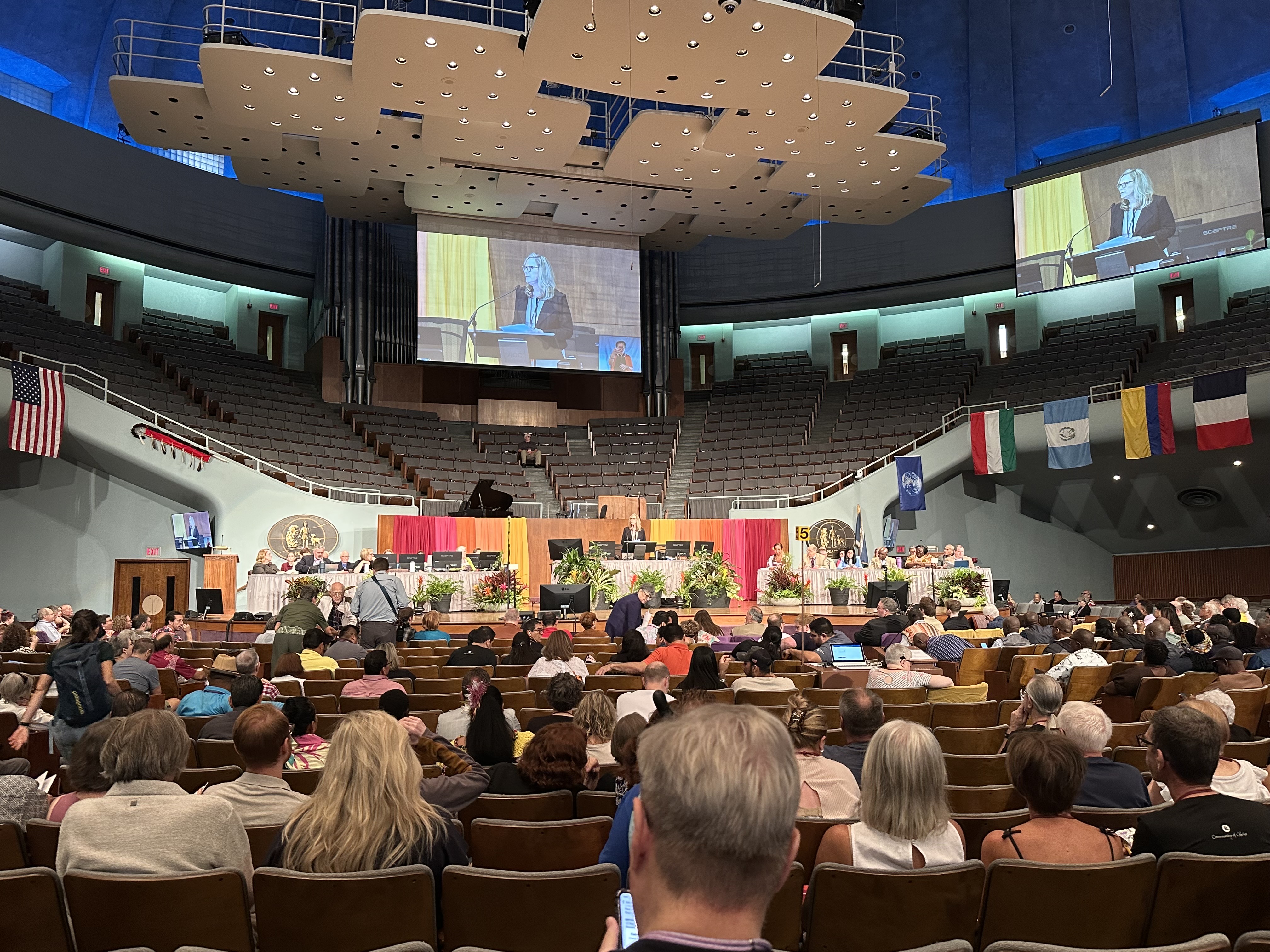
Haven’t we all had moments where Jesus gave us an answer that we weren’t expecting? 41 years after the World Conference where Apostle Charles Neff retired, I was in Independence, Missouri for the 2025 World Conference. This time, it was Steve Veazey, the president of our denomination, who was retiring, and Stassi Cramm was set to succeed him. It was a historic moment, the first time that our denomination would be led by a woman. I wanted to be there for it, and I wanted my daughter, Élo, to be there for it.
One of the reasons that I joined Community of Christ a few years ago is because this is a church where—ever since that exciting World Conference in 1984—women can be leaders. I wanted to be active in a church where she could see that example. Now, it turns out that church is not the most interesting thing in the world for her, and that’s okay, but for this particular moment, I really wanted her to be there, so that she could see what it looked like for a church to be led by a woman.
However, Stassi’s ordination service was at the end of a very long day. Élo was still getting used to the different time zone, we hadn’t seen much of each other during the day, and she was just tired, and bored, and fidgety. We struck a compromise: We would stick around just long enough so that Daddy could see the historic moment that he had come for, but instead of staying for the singing and the celebration that Daddy had also been looking forward to, we would get Élo home so that she could read and go to bed.
That’s what we did, and I have to admit that I was grumpy about it at first. After I calmed down some, though, I concluded that if one of my big motivations for being in this church is for the sake of my daughter, maybe my daughter can sometimes—not all the time, but definitely sometimes—be a motivation for missing church stuff. That was not the conclusion that I was expecting: church is important! It’s certainly not the one that I wanted in the moment: that ordination service was once-in-a-lifetime! But sometimes, our priorities conflict, and sometimes Jesus comes to us with an unexpected answer of how to resolve them.
conclusion
I look up to Apostle Neff’s fierce disapproval of violence and injustice in the world, and I often wish I had his fire. At the same time, even though I’m surprised that Jesus is more willing to compromise, this is Jesus we’re talking about: it’s probably worth paying attention to his approach. I don’t know how to resolve all of these complicated feelings, but I do know two things: First, sometimes our priorities are going to conflict with each other. Second, as we work to discern what God’s spirit wants us to do in a particular moment, sometimes we’ll get unexpected answers.
- Charles Neff
- taxes
- non-violence
- sermons
- Community of Christ
- Jacques Ellul
- Presence in the Modern World
- World Conference
- World Conference 2025
similar posts:
sermon on dreaming of a better world
One of the fun things (for me) about attending World Conference is remembering how much more useful French is in Community of Christ contexts than LDS contexts.
Here’s Stassi Cramm presiding at Community of Christ World Conference after being ordained last night as our church’s first female prophet-president.
📚 bookblog: Christ in the Rubble: Faith, the Bible, and the Genocide in Gaza (❤️❤️❤️❤️❤️)
Jacques Ellul and Civilization VI
comments:
You can click on the < button in the top-right of your browser window to read and write comments on this post with Hypothesis.