Below are posts associated with the “generative AI” tag.
🔗 linkblog: Apple WWDC 2024: the 13 biggest announcements'
I’ve been feeling for a while like I need to move away from Apple eventually, but I’m so entangled in the ecosystem that I’m dragging my feet on it. Seeing the company drink the AI Kool-Aid is definitely accelerating my plans—and will even more so if there’s no easy way to turn these featutes off.
🔗 linkblog: Journalists “deeply troubled” by OpenAI’s content deals with Vox, The Atlantic'
In a roundabout way, I think this helps demonstrate why scraping data for generative AI isn’t a question of copyright. Even when there is a legal agreement, it can still be exploitative—it’s a question of digital labor.
🔗 linkblog: Decentralized Systems Will Be Necessary To Stop Google From Putting The Web Into Managed Decline'
Some good thoughts here by Masnick.
🔗 linkblog: OpenAI loses its voice'
Look, it shouldn’t take this story for people to realize that OpenAI exploits others’ contributions to make its products, but if it does the trick, I’ll take it. (And this is admittedly creepier than its base-level exploitation.)
🔗 linkblog: Pluralistic: You were promised a jetpack by liars (17 May 2024) – Pluralistic: Daily links from Cory Doctorow'
Compelling essay about vain hopes for the future.
🔗 linkblog: Microsoft’s AI obsession is jeopardizing its climate ambitions'
Such a depressing article.
🔗 linkblog: Stack Overflow users sabotage their posts after OpenAI deal'
Some better, broader coverage of complaints I made in a blog post earlier this week.
🔗 linkblog: OpenAI, Mass Scraper of Copyrighted Work, Claims Copyright Over Subreddit's Logo'
I don’t think intellectual property is the way to fight back against generative AI, but it is wildly out of line for a company who profits off using other’s intellectual property to be this petty.
Stack Exchange and digital labor
Today, Stack Overflow announced that it was entering into a partnership with OpenAI to provide data from the former to the latter for the purposes of training ChatGPT, etc. I’ve used Stack Overflow a fair amount over the years, and there have also been times where I tried to get into some of the other Stack Exchange sites, contributing both questions and answers. I haven’t really been active on any of these sites in recent times, but I still decided to take a couple of minutes this afternoon and follow the advice of one outraged Mastodon post: delete my contributions and shut down my accounts.
assessment as proof of learning or as learning itself?
Recently, an idea has been bubbling in my head that’s the culmination of months—even years—of thinking about how I assess in my courses. I’ve typically taken the pretty-standard approach that assessment is the process of students’ proving that they’ve learned something. What if, though, assessment is itself the proof of the process of students’ learning something. That is, what if we doled out points for students’ proving that they appropriately participated in learning activities and then trusted the learning to happen on its own?
🔗 linkblog: AI isn't useless. But is it worth it?'
I think this might be one of the best things I’ve read on generative AI.
🔗 linkblog: Teen Girls Confront an Epidemic of Deepfake Nudes in Schools'
Sure, Midjourney is fun, but this is the price we’re paying for that kind of technology out in the world.
Arthur Dent, the bulldozer, and generative AI
This week, I decided to see if it was worth relistening to the original Hitchhiker’s Guide to the Galaxy radio series. I’m having trouble committing to things to listen to right now, and I’ve found in recent years that I don’t enjoy H2G2 as much as I once did, so it’s hard to say whether I’ll follow through with this. However, I did get far enough in to the first episode to enjoy Arthur Dent’s confrontation with Mr. Prosser, the man who wants to knock over Dent’s house to build a bypass.
🔗 linkblog: AI already uses as much energy as a small country. It’s only the beginning.'
There are some important and interesting pieces of information in here.
do you want to be good or to be optimized?
This Saturday Morning Breakfast Cereal comic from yesterday spoke to me at a deep level:
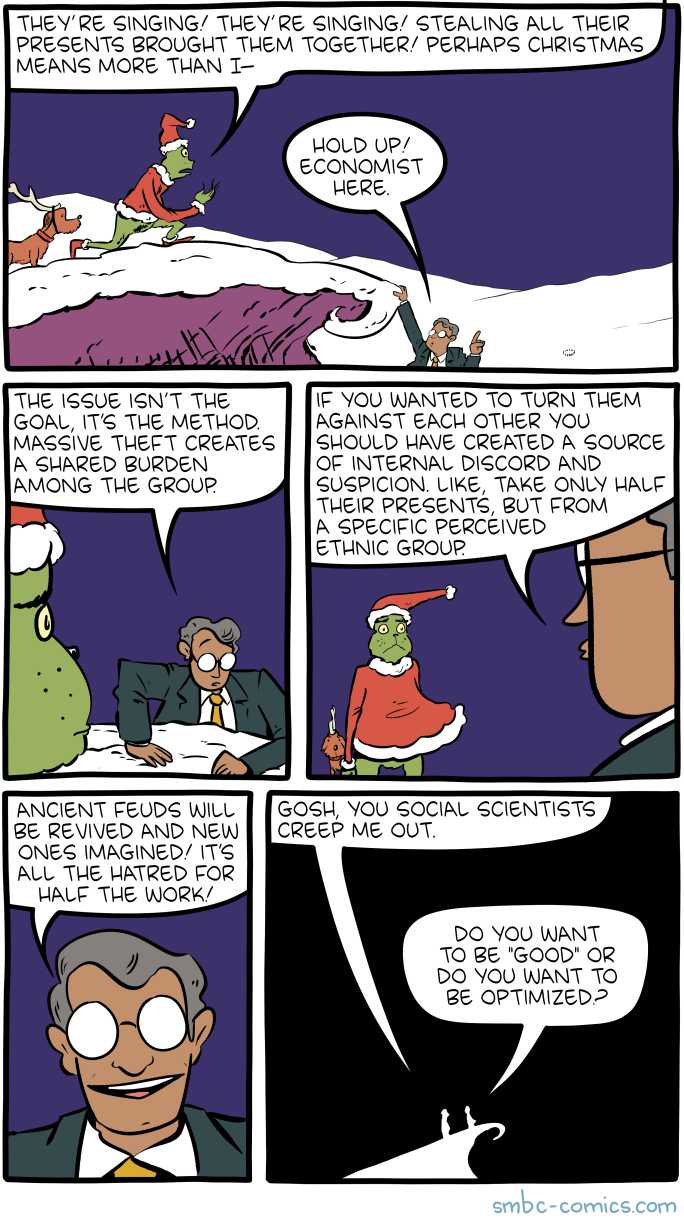
My first thoughts went to generative AI, an area in which I feel like a fetishization of optimization is crowding out really important questions of what is good. As I put it in a university survey earlier today, there are undeniable benefits to the use of AI tools, but there are important questions as to who benefits. If my department started to use generative AI as a note-taking tool in faculty meetings (the specific focus of this survey), we would probably benefit from it!
🔗 linkblog: The job applicants shut out by AI: ‘The interviewer sounded like Siri’'
So, if employers save time from AI, and applicants save time from AI, where’s the net benefit? Or does it become a new burden for everyone?
🔗 linkblog: AI’s craving for data is matched only by a runaway thirst for water and energy | John Naughton'
Bookmarking for future reference. Are the purported benefits of generative AI worth these (and other) costs?
🔗 linkblog: Amazon Turkers Who Train AI Say They’re Locked Out of Their Work and Money'
Helpful reminder that it’s low-paid, underappreciated workers who contribute to AI as much as high-paid programmers and household-name executives.
🔗 linkblog: Fanfiction Community Rocked By Etsy Sellers Turning Their Work Into Bound Books'
This strikes me as illustrating the digital labor issues associated with generative AI. It’s someone else profiting off of one’s work.
🔗 linkblog: Tumblr and Wordpress to Sell Users’ Data to Train AI Tools'
Aw, geez, and I liked Automattic, too. I get that financing Tumblr is hard, but why this?
🔗 linkblog: Reddit: 'We Are in the Early Stages of Monetizing Our User Base''
There are few phrases grosser than “monetizing our user base.”
🔗 linkblog: Reddit Signs $60 Million Deal to Scrape Your Online Community for AI Parts: Report'
Look, I’ve never been really into Reddit, but I’m still really disappointed in the company. This sucks.