Below are posts associated with the “surveillance” tag.
🔗 linkblog: Flock is catching flak. Experts say other police surveillance tools are more worrisome
Getting rid of Flock is an important step but just the first one.
🔗 linkblog: Meta's $17 Billion Settlement is a Bad Deal for Teens and All Social Media Users
Only skimmed this—and it deserves a more thorough reading—but it’s a good reminder that “Meta is awful” does not justify all constraints on Meta.
🔗 linkblog: I Asked 100 Companies for My Data. I Got Deletion Notices Instead
What a wild, frustrating experience.
🔗 linkblog: McDonald’s Built a 515-Page Dossier on Me. It Says I’ll Never Stop Eating There
Glad I went back to read this after originally missing the article. Here’s a heck of a paragraph:
While the sheer amount of data McDonald’s stored over the years caught me off guard at first, the way it was used by the company’s predictive algorithms was what I found most concerning. The company predicted how often I would visit in the next six weeks (2.16 times), what I would spend on average ($13.49), and what I would spend in total ($29.15). One reporter at WIRED joked that McDonald’s had created a Minority Report-style dossier to predict my next snack wrap purchase.
🔗 linkblog: Lexington residents push back against Flock cameras at council meeting
Hell yes. Disappointed in myself for not being one of these people.
🔗 linkblog: Meta glasses are a workplace menace
Hard article to read, but an important one. Here’s the thing: I know two people who own Meta “pervert glasses,” and I think if there is an innocuous use case for these glasses, they’re demonstrating it.
And yet, here’s Ellul on technical ambivalence:
And this technological nexus is characteristically ambivalent. Because the solution of one problem by technological means immediately raises a multitude of others, which result directly from those very means, it is impossible to say whether technique produces good or evil effects. It does both, simultaneously. We are confronted with a system in the strict sense of the word, what I will call the “technological system,” hence ethical issues may only be considered relative to the system as a whole, and not to specific instances.
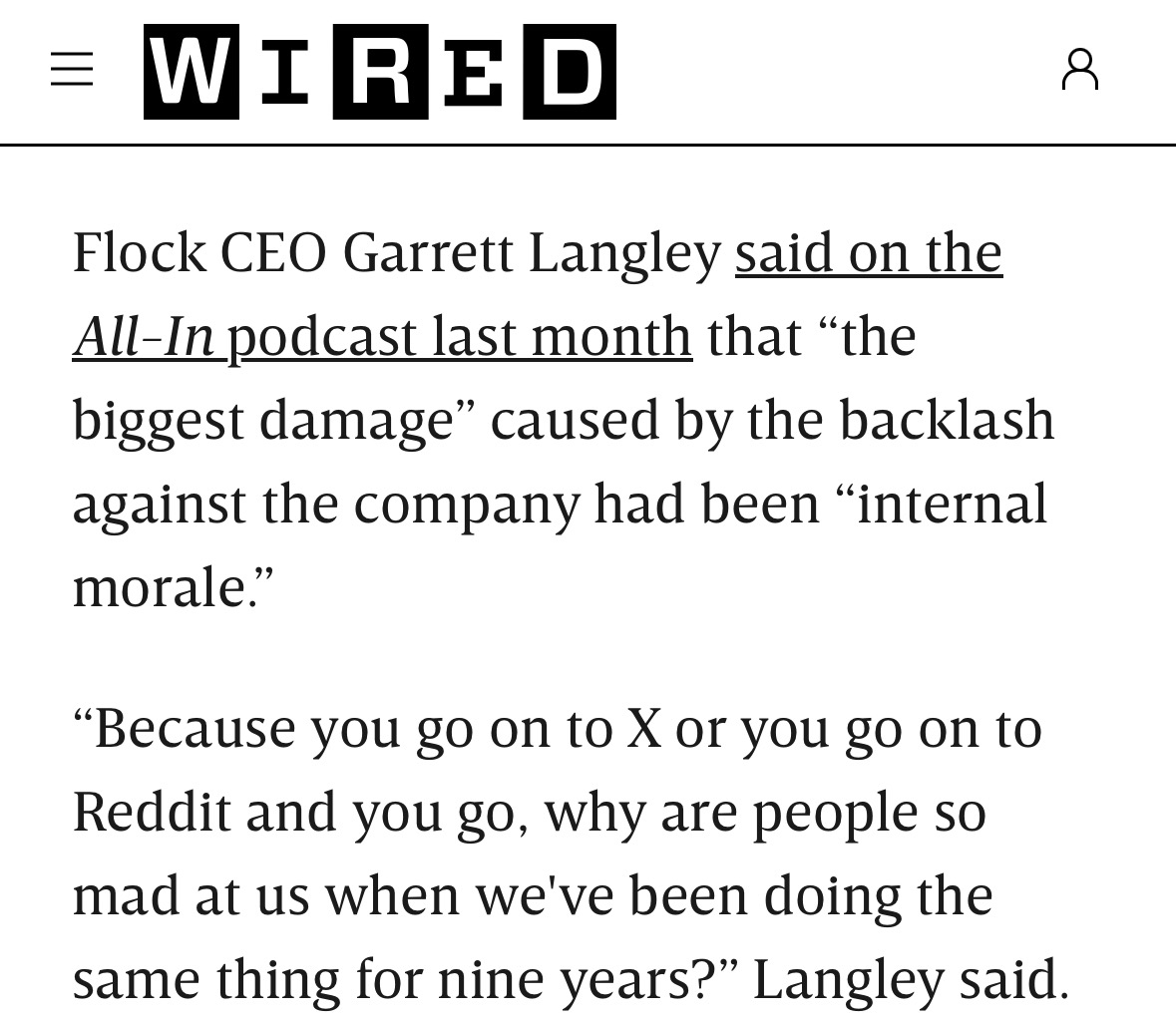
🔗 linkblog: Flock CEO: ‘We got this one wrong’
This response is such a CEO way to apologize for something:
“It took me maybe longer than it should have to realize the sheer impact of the company,” he says. “I’m still surprised. I got our July update a week ago, and we helped find almost a thousand missing people, over 22,000 stolen cars — in July. That’s crazy. That’s such a big impact on the world. And what I came to realize over time was that the responsibility that bears with it is an obligation to make sure that it’s creating a society that we both, you and I, and everyone around us, want to raise their kids in.”
🔗 linkblog: Flock Pitched a Plan To Turn Uber and Lyft Drivers Into Roaming Surveillance Vehicles
Love a company response that comes down to “sure, we talked about it, but we didn’t actually do it.”
🔗 linkblog: Meta just created a moderation nightmare for its smart glasses
Hard to pick a single killer line from this one. There’s this paragraph:
Appreciate for a moment the bind Meta finds itself in: Its product allowed customers to behave so objectionably that the company responded with a content ban, as if to say “Stop making us look bad.”
And then this conclusion hits hard:
In saying the company will police the creepiest version of smart glasses content but sidestepping deeper questions, Meta is trying to have it both ways: It gets to tout its enforcement while creating the conditions for this content to exist in the first place.
🔗 linkblog: “Digital Colonialism”: U.S. Demands To Access Africans’ Data Raise Privacy, Sovereignty Concerns
Looks like the Trump administration is responding to dumb decisions and cynical cuts with pure exploitation:
After withdrawing from the World Health Organization and losing access to its global network that tracks and combats disease outbreaks, the U.S. is attempting to obtain the information necessary to address potential pandemics through a patchwork of deals with individual countries
🔗 linkblog: Cops Say Waymo Snitched on Teens for Allegedly Drinking and Shooting a Toy Gun
Self-driving cars are surveillance machines.
🔗 linkblog: ‘BusPatrol’ Put AI Cameras in Tens of Thousands of School Buses. Now They Want to Give Cops Access
If edtech doesn’t include this horrifying monstrosity, the field isn’t being broad enough in its inquiry.
🔗 linkblog: How OpenAI caved to the Pentagon on AI surveillance
An important read on OpenAI’s seeming selling out.
🔗 linkblog: Meta won’t let morality get in the way of a product launch
Don’t think I’ve posted anything on this story yet because as the article points out, it’s hard to focus on this evil with so many other evils distracting us.
🔗 linkblog: Leaked Email Suggests Ring Plans to Expand ‘Search Party’ Surveillance Beyond Dogs
Who could possibly have predicted this?