Below are posts associated with the “macro” type.
thoughts on recent Mormon Land podcast
The Salt Lake Tribune’s Mormon Land podcast is one of my favorites—I’ve gone so far as to support it on Patreon so that I can get all the Tribune’s religion coverage without having to subscribe to the entire newspaper. Mormon news interests me a lot, but Utah news doesn’t interest me at all. Yesterday’s episode on age and Latter-day Saint leadership was one of the most interesting episodes that I’ve listened to. In particular, two of Greg Prince’s comments during his interview stood out to me.
non-appearance on 'The Unlistenable Podcast'
A few weeks ago, I sat down with Lexi Lishinski, a good friend from grad school, to appear on an episode of her podcast The Unlistenable Podcast. To quote the About page for the podcast:
It’s not called that because it has dreadful audio quality, although that may be true. It’s called that because you can’t listen to it, because I’m not going to release the episodes. This solves literally every issue that ever stopped me from recording a podcast.
on distinctions between 'church' and gospel'
During the last few years I spent as a practicing Latter-day Saint, one recurring pet peeve that I had was the overbroad use of the term “gospel” to refer to all Latter-day Saint doctrines, teachings, and beliefs. In hindsight, learning to separate the good news of the gospel of Jesus Christ from everything that I believed was a major part of my faith transition—and my ability to continue in Christianity even when the version that I was used to started to no longer work for me.
ClassDojo and educational 'accomplishment'
As kiddo’s school year has gotten into full swing and mine has gotten busier, I’ve spent less time griping about her school’s use of ClassDojo. However, I’ve also become increasingly annoyed at the fact that the weekly update email I get from the company always has the subject line “What did your child accomplish this week?” The body of the email is divided into two sections: The number of “points” that my child was assigned, and the number of “stories” that my child appeared in. Do points and stories reflect accomplishment?
the problem with Gadianton robber rhetoric
After recently finishing an excellent biography on Brigham Young, I’m starting to make my way through some other Mormon Studies books that I own but have not yet read. This has brought me to Paul Reeve’s Religion of a Different Color: Race and the Mormon Struggle for Whiteness. It’s very good so far, and I regret having waited until now to read it. I’m currently working through Reeve’s chapters describing Mormons’ relationship with American Indians, and I just now read a paragraph that really surprised me. First, though, some background:
Lance Eaton on the invasive surveillance of LMSs
This week, I’m hurriedly putting together some revisions for a book chapter on data ethics that I’ve been working on for an open access volume on ethics in educational technology. I’m excited about the volume, and I’ve really loved writing the chapter, so it’s kind of fun to be doing these revisions, even if I waited for the last minute to do them.
One reviewer suggestion that I’m particularly grateful for is to elaborate on a sentence I wrote arguing that “learning management systems allow us to monitor students in invasive ways that would be unimaginable in a face-to-face context.” In making that argument, I was drawing from Lance Eaton’s 2021 article The New LMS Rule: Transparency Working Both Ways, which I’ve taken a lot from. Here’s the whole paragraph that I had in mind—and that I’ll be taking inspiration from as I respond to this reviewer’s suggestion:
being present and « Les Cowboys Fringants »
A couple of weeks ago, I was invited to preprare a “focus moment” for today’s worship service in my Community of Christ congregation. There are some things I might change for a different audience (putting more nuance into my current view of God, for example), but I’m still pretty happy with what I came up with. I’m particularly happy about the translation of the song—I didn’t bring it up when sharing, but this is a French Canadian song that I translated for today’s purpose. I recently blogged about this same song, because I’ve been listening to it for years but only just recently learned what the words actually meant (this happens a lot to me in French music). I ended up learning a some new French Canadian vocabulary from this, and I’m pleased with how I managed to translate the lyrics in a way that mostly preserves rhymes and rhythm in English.
old video games, libraries, and xkcd
There’s a great xkcd strip (see below) about someone who always plays video games on a five-year lag because you get to enjoy all the good games with less of a hassle:
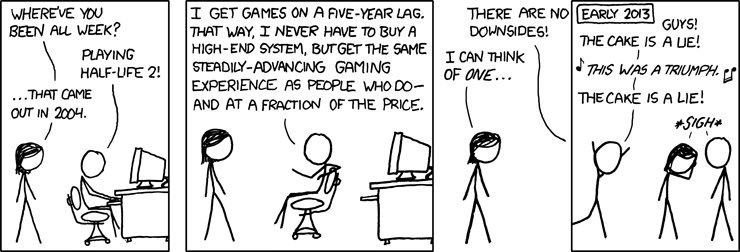
I love this strip for a few different reasons. First of all, I’ve never been a hardcore videogamer, so if I do ever play a big title, it usually is about five years after the fact. Second, I think there’s something about it that gets funnier (or else makes me feel older) over time: It’s funny to think of someone only discovering Portal in early 2013, but now that “five years late” is almost “ten years ago,” there’s something kind of absurd about the strip. At any rate, I wish that Portal were still supported by modern macOS, because even if that’s 15 years late, I would gladly play through the game again. In fact, I wanted to show it to kiddo a couple of months ago and was frustrated that I couldn’t!
standing the wrong way in the elevator: a response to Oaks and Gilbert
I ride an e-bike into work, and because an e-bike is expensive, I bring it into my office rather than lock it up at one of the bike racks on University of Kentucky campus. Because an e-bike is heavy, I also take it up the elevator to get up to the third floor, where my office is. My e-bike takes up a lot of space, but I’ve figured out how to share the elevator with others as I make my way up to my office. I lead my bike in, getting the front wheel as far toward the back of the elevator as I can, and then swing it around to the left as I pick up my rear wheel and try to tuck it in to the opposite (front) corner of the elevator. It takes a little bit of effort, but I know I can get it in there; because I also know it’s going to take some effort to get my bike out, I usually face the rear of the elevator during the ride, which is short enough that there’s no point in turning around to face “the front” of the elevator only to turn back around again to take control of my handlebars and wheel the bike back out.
finding awe in MocMoc and other little things
Yesterday, two podcasts that I listened to while doing work around the house lined up in such a perfect way that I wanted to write down my memory of the moment. First, because I was recently reminded of the fantastic podcast Harry Potter and the Sacred Text (which applies sacred reading techniques to the Harry Potter series, treating it as serious and meaningful without letting it—or its author—off the hook for being problematic), I’ve been trying to catch up with its second runthrough of the book series, in the perhaps-vain hope that I can start listening to episodes as they come out. In one episode I listened to yesterday, the hosts spoke on the theme of awe. One of the hosts put it this way:
sticking with the Book of Mormon
I am a big fan of the Book of Mormon. It’s one of the reasons that I stuck with Community of Christ when transitioning out of The Church of Jesus Christ of Latter-day Saints. I know the book is problematic, and I doubt its historicity, but I’m still an advocate for making some religious meaning out of it.
There are diverse opinions about the Book of Mormon in Community of Christ, and while there’s plenty of room to believe lots of different things, the default institutional view tends to be either indifferent or suspicious of the text. There are some good reasons for that—not least the increasingly international focus of Community of Christ—but I still sometimes feel like I’m not sure why people don’t embrace the Book of Mormon more.
apprendre (enfin) les paroles des chansons franco-canadiennes
J’ai commencé à écouter la musique francophone il y a onze ans. Avant ça, j’avais quelques albums (Caféine de Christophe Willem et la bande originale de Le Roi Soleil), et je connaissais Serge Gainsbourg, mais selon mes souvenirs, j’ai du attendre janvier 2011 pour me foncer vraiment dans la musique en français.
En ce temps, je commençais un poste comme « instructeur étudiant » du français à l’université où je faisais mes propres études. Pendant une réunion de formation, la représentante de l’entreprise qui publiait notre manuel nous a donné des cartes cadeaux iTunes pour qu’on puisse acheter de la musique francophone et nous inspirer professionnellement. À l’époque, c’était bien plus facile de trouver de la musique franco-canadienne que de la musique francophone européenne, et j’ai donc acheté quelques pistes des groupes comme Mes aïeux et Les Cowboys fringants. Peu après, j’ai découvert Les Trois Accords, et la musique franco-canadienne est ensuite devenu un élément important de ma bibliothèque musicale. Quelques années plus tard, pendant mes études de doctorat, j’ai passé un peu de temps avec Spotify (avant d’abandonner définitivement) et beaucoup de temps avec la radio en ligne, et ces deux ressources m’ont aidé à approfondir ma connaissance de la musique francophone.
Oaks and Benson on love of God and neighbor
Dallin Oaks, the second highest-ranking apostle in The Church of Jesus Christ of Latter-day Saints, gave a speech at Brigham Young University yesterday where he touched on the “two great commandments” identified by Jesus in the Book of Mark. Unsurprisingly for anyone who’s been following recent signals of retrenchment at BYU (or anyone familiar with the apostle for that matter), Oaks put the two commandments in a particular order. Here’s how the Salt Lake Tribune quotes him:
listening to Handel's Messiah in September
I’ve never had qualms about listening to Christmas music outside of December, but it still surprises me that I’ve been listening to parts of Handel’s Messiah during my morning routines over the past couple of weeks. I’ve never been the biggest fan of the music of Messiah, and in recent years, I’ve let go of my attachment to King James language and learned that a lot of the passages quoted in Messiah represent Christian prooftexting of the Hebrew Bible (here’s a great post on the subject by Pete Enns—and here’s another). In theory, this ought to sour me on Messiah even more, but I’ve spent a big chunk of this morning listening to this performance of excerpts—and really enjoying it!
Wil Wheaton on general purpose computing
I am very near the end of Wil Wheaton’s updated/annotated memoir Still Just a Geek, which I bought over the summer on a short family trip. I have lots of thoughts—most of them positive—about the memoir and may write a bit more about it once I finally finish. For now, though, since I wrote last week complaining about companies like Apple and ClassDojo restricting hardware and software to support their bottom line at the expense of users, I was struck by a short passage Wheaton included making a case for general purpose computing:
new report on Google Classroom and ClassDojo
I have been writing a lot about ClassDojo recently, spurred by a combination of my professional concerns about the app and by my frustration that my kid’s school is now using it. Last week, I was pleased to see a new report from the United Kingdom-based Digital Futures Commission about not only ClassDojo but also Google Classroom. I’m sure my kid will have to use this latter software as well, so it’s good to be aware.
to be loved is to be 'liked'
Thanks to the magic of the internet, I often listen to Francophone radio stations while working (most often French and Swiss—Radio-Canada doesn’t support streaming outside its own apps and sites). This is a great way to keep up with my French, and because there seems to be a minigenre of Francophone songs critiquing social media (Stromae’s Carmen comes to mind, but there’s at least one other whose name I can’t remember right now), it sometimes ends up being professionally relevant as well.
putting my work where my whining is
Early in the school year, I signed up to be a parent representative on one of the Site-Based Decision Making (SBDM) committees for kiddo’s school. I had already started being a rabble-rouser about ClassDojo and some of my other edtech concerns, and I wanted to show that I could put in work where my whining was: That is, that I wasn’t just going to complain about things, but that I was going to show support for the school by helping out where I could. Besides, I have long term aspirations to run for a school board seat, so this seems like a good way to work my way there; also, I’d guess there aren’t as many dads as moms that are available for 3pm committee meetings (hooray for a flexible academic’s schedule!), so I figured I’d try to balance out some of the gender representation there.
ClassDojo and the creation of artificial demand
Yesterday, I complained about Apple putting artificial limitations on what its hardware and software can do in terms of music syncing in order to make more money out of its consumers (and, probably, keep music companies happy). As I was writing that, I was thinking about similarities with the business model of a lot of mobile apps—let people download the app for free, but keep bonus features (or even the best features) behind a paywall. I understand that business models for apps are tricky, and after a childhood and young adulthood of delighting in how much is free on the internet, I’m finally starting to understand that it’s important to spend money on software and content that we care about. However, it bugs me when this kind of model is used when it doesn’t need to be. Apple is fantastically wealthy and doesn’t need to nickel and dime us like this.
pourquoi le français ?
Hier soir, juste avant de me coucher, quelqu’un a posé une question sur r/French: Pourquoi les non-Francophones choisissent-ils d’apprendre le français ?
J’ai vu la question peu après qu’elle a été posée, et j’ai dit la vérité : On m’avait offert le choix entre les cours de français et les cours d’espagnol. Il y avait plus de monde qui voulaient étudier l’espagnol, et j’avais envie de contrarier. J’ai donc choisi le français comme acte de rébellion.
Apple and artificial restrictions on file syncing
A week ago today, my MacBook Pro suddenly stopped being able to communicate with its SSD. I’m not entirely sure what happened, but I spent most of my Tuesday afternoon wiping everything from the drive and reinstalling macOS so that I could get back to work. While I haven’t kept a physical backup for a couple of years (I accidentally fried mine when moving back into my campus office in Fall 2020), I have all of my most important documents scattered between three cloud services, so this wasn’t too painful of a process.
musical references in TMBG discography
Thanks to a recommendation from Boing Boing, I’ve spent part of this afternoon watching this amazing video cataloging “Every Music Reference & Sample in They Might Be Giants Songs”:
Flood was one of the first albums I ever owned (I think it was beat by the deluxe soundtrack for Star Wars: A New Hope, but not by much), and while I don’t listen to TMBG as often as I ought to, videos like these remind me how much I love the band. I’ve mostly appreciated them for their weirdness, but it’s been amazing to see how aware they are of other music and how they bring it into their own discography. This is also a beautiful example of everything being a remix—we ought to spend more time supporting that rather than constraining it.
data privacy and kiddo's school
In addition to all the irritating ClassDojo stuff going on at kiddo’s school, I’ve also spent some time banging my head against the wall made up of two forms: One to opt out of FERPA directory information sharing, and the other to opt out of kiddo’s information being shared with media outlets. I’m too tired tonight to get into all the details of what’s been going on, but the short version is that there’s no (clear, easy) way for spouse and I to request that kiddo’s name and image not be shared on school social media without also insisting that kiddo’s name and image not appear in innocuous things like… a school yearbook.
some thoughts on platforms and 'community'
I’ve thought a lot about “community” in online spaces over the course of my (still-short) academic career. Early drafts of my dissertation had a lengthy discussion about the benefits and disadvantages of Étienne Wenger’s community of practice framework (which emerged from Wenger’s work with Jean Lave) as compared to James Paul Gee’s affinity space framework. From a research perspective, I tend to prefer Gee’s space-focused perspective and agree with many of his arguments for why it makes more sense to use that language in an online setting.
ClassDojo and 'data as oil'
The new semester at the University of Kentucky starts on Monday, and I am flailing to try to get my data science course ready to go—including putting together an open, alternative textbook for my students. I’ve been borrowing heavily from Catherine D’Ignazio and Lauren Klein’s Data Feminism for my textbook: It’s a fantastic resource, and I’m hoping my students take a lot from it.
Of course, my kid’s semester has already started, and I’ve already blogged a bunch about my frustrations with her new school’s use of ClassDojo this year. It turns out that Data Feminism is also a helpful resource here. Riffing on the common “data is the new oil” metaphor, D’Ignazio and Klein argue that: