Below are posts associated with the “macro” type.
movie posters and sacramental living
I just spent way too long (even longer because I insisted on doing it in French) writing up a post about movie posters I remember seeing in France and Switzerland while living there as a Latter-day Saint missionary. I have final grading to do and a lawn to mow, but those specific memories of movie posters pop up every once in a while (despite, as I explain in the first post, not really being much of a movie buff?), and this morning, it felt like I wanted to capture them before they disappear on me. I have many, many dumb little memories like that of my time as a missionary, and even as the fact itself of being a Latter-day Saint missionary gets more complicated for me (thanks to dramatic changes in my religious life), those tiny memories continue to feel valuable and important to me.
affiches de cinéma dont je me souviens
Ayant grandi dans l’Église de Jésus-Christ des saints des derniers jours, c’était normal que je m’engage comme missionnaire mormon à l’âge de 19 ans. Comme j’avais déjà beaucoup étudié le français, on m’a affecté au service missionnaire en France et en Suisse, où j’ai donc habité entre 2007 et 2009.
Mes souvenirs de cette période de ma vie sont un peu compliqués. Comme je n’ai plus les mêmes croyances religieuses, j’ai certains regrets. Comme c’était quand-même très cool de vivre en Europe francophone pendant deux ans, j’éprouve quand-même de la nostalgie pour cette saison de ma vie.
preaching on Revelation: hope, weirdness, and being anti-empire
Last Sunday, I preached in my Community of Christ congregation, beginning five weeks of messages from Revelation. This sermon came together with more difficulty than the last few that I’ve done, but I took advantage of being the first person preaching on Revelation by setting the stage for a responsible reading of the book as about the past, not the future. I attend a relatively conservative Community of Christ congregation, so it was unsurprising to get some pushback on that, I guess. I also managed to work one of my favorite novels into that explanation, which was fun. I think I could have gone harder with the message of anti-imperialism, but I’m pleased with what I did fit in there.
new publication: documenting a teacher group on far-right social media
I’m pleased to be able to finally share the publication in the British Journal of Educational Technology of an article that Dan Krutka and I have been working on for some time, which documents activity in a teachers’ group on a far-right social media platform (which we intentionally don’t identify within the paper). Here’s a link to a full-text, read-only version of the article, and here’s the abstract as a preview:
going semi-viral on Bluesky just made me miss blogging
Since early 2019(!), I’ve been slowly but surely orienting my online presence around my Hugo blog. This doesn’t mean that I’ve given up on social media platforms, but that those are merely appendages to a website that I have more control over. In fact, I’m really pleased with the POSSE—Post to Own Site, Syndicate Elsewhere—setup that I’ve developed over the past couple of years. It currently works like this: All of my posts start on this website, and then I use the EchoFeed service to send posts to my Mastodon accounts and a Bluesky account (Micro.blog also imports my posts via RSS).
DuckDuckGo and IP geolocation (with a MapQuest and generative AI tangent)
I don’t know if this is a DuckDuckGo thing or an underlying Bing thing, but I’ve started noticing something weird happening when I search for things that don’t get a lot of results. When it happened again earlier this week, I finally grabbed a screenshot:
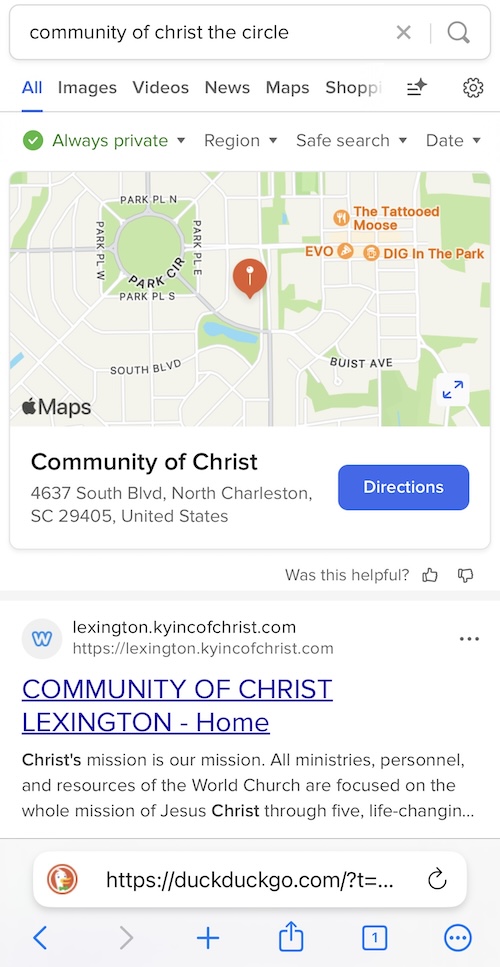
So, here I am searching for something related to the (relatively obscure, relatively progressive) religious denomination I belong to, and when DDG (or maybe Bing) couldn’t find anything related to the specific thing I was searching for, the first text result that it gave me was the best result it could find for a subset of my search matched with the town I live in: Lexington, Kentucky.
the upside-down Blue Marble and imagining other worlds
One of the most famous photographs in the world is the Blue Marble, a picture of Earth taken from Apollo 17 as it made its way to the Moon.

I learned something interesting about the photo today, though: Apparently (see here, among other sources, though I wish I could find a NASA comment on this), the photo was originally taken with the South Pole facing the top of the photo—and with the Earth not exactly centered. Frequently, though, it’s displayed with a vertical flip and some cropping so that it matches our expectations of what the Earth looks like.
Star Trek V, the Liahona, and Jacques Ellul's technique
Despite what my recent Star Trek comics binge might lead you to believe, my Star Trek fandom is actually kind of spotty in its coverage. It’s not so complete that I’ve ever actually seen Star Trek V (though I hear I’m not missing much), but it’s absolutely complete enough to be familiar with its most famous line. A being claiming to be the ultimate, galaxy-wide monotheistic deity asks for transport on the Enterprise, prompting a skeptical Kirk to ask “what does God need with a starship?”
nontheism in one of Steven Peck's short stories
I recently reread Steven Peck’s Wandering Realities, a collection of short stories on Mormonism. One of the more moving stories in the collection is “Two Dog Dose,” which features two old friends, one of whom is still a practicing Latter-day Saint while the other is not. That second character is one of those characters who is more interesting than the brief format has room for: We never learn exactly what led to his loss of faith, but we do learn that he had served as a bishop at some point before that happened. There are tantalizing hints of a rich character that can’t be contained in a short story but who is all the more interesting because that’s all we get of him.
moral surrender, the environment, and generative AI
Last week, I blogged about how the purported inevitability of generative AI gets used to sidestep moral concerns about it. Earlier this morning, I shared a link to a story from The Verge that illustrates that perfectly, and so I wanted to write just a little bit more about it.
First, let’s quote some more from Jacques Ellul, whom I referenced in the last post (and whom I’ve just been referencing a lot in general recently). Right before the passage I quoted in last week’s post—a passage from his 1980 essay The Power of Technique and the Ethics of Non-Power, he had this to say:
two things that bug me about arguments that generative AI is inevitable or whatever
I don’t know that “inevitable” is the right word to use in the title of this post. What I’m trying to evoke is that specific argument about generative AI that now that it’s here, there’s no going back, so the only real/responsible/whatever choice is to learn to use it properly, teach others to use it, accept it as part of life, etc. These are the arguments that the world is forever changed and that there’s no going back—that the genie is out of the bottle so we might as well harness it.
some brief notes on the theme song to The NeverEnding Story
I have vague recollections of watching The NeverEnding Story as a child, but they are vague. I was young (nine at the oldest, but probably younger), it was at someone else’s house, and it was only once, so it didn’t leave much of an impression on me. My next substantive encounter with that movie—or, more accurately, its theme song—was the ending gag in this Homestar Runner cartoon, where the title character sings “the never ending sooooodaaaaaa” to the tune of the movie’s theme song.
Jacques Ellul's technique and Brian Daley's Alderaan
I recently finished an audiobook of Jacques Ellul’s The Technological Society and have been finding other things to listen to now that I don’t have mid-twentieth century French philosophical reflections on technique to think through anymore. Last night, I began (re)listening to the National Public Radio Star Wars radio drama—adapted by Brian Daley—while cleaning up the kitchen, and I continued listening on the way in to work today. The radio drama is interesting in so many ways! For one, it expands a two hour movie into a nearly six-hour radio serial, and so it crams in a lot of material that isn’t present in the movie (or even—as far as I can tell—the original script).
the bronze serpent as anti-universalism and religious exclusivism in the Book of Mormon
Today’s Community of Christ lectionary passage is from 1 Corinthians 10, and includes this, from verse 9 (NRSVUE):
We must not put Christ to the test, as some of them did, and were destroyed by serpents.
This is one of a few different stories that Paul evokes in 1 Corinthians 10 that all rub me the wrong way (I’m not a big fan of any punitive God), but this one stands out in particular because it reminds me of how the “serpents” story (originally in Numbers 21) gets evoked twice in the Book of Mormon. Here they are, from Community of Christ’s Revised Authorized Version:
Jacques Ellul and the value of research
Last month, I wrote on both my reading up on Jacques Ellul and on concerns about how we understand the purpose and value of research. I’m continuing to read—or, rather, listen to—Ellul’s The Technological Society, and I was interested to find a passage that brought together these two ideas. Here’s Ellul, writing in the mid-twentieth century:
We have already examined the requirement of immediate applicability; here we meet it again on the state level. The state is not disinterested any more than private capitalists, but it is concerned in a different way. The state claims to represent the public interest and hence to have the duty of being a “good manager,” dispensing the public revenues only on condition that they mean something, that they pay off. Disinterested activity on the part of the state is inconceivable. Some may such that such activity should not be impossible; but in fact it is impossible. Neither individuals nor public opinion nor the structure of the state is oriented toward the acceptance of the kind of culture pure scientific research would represent.
why I want to reread Cory Doctorow's 'For the Win' despite all the other books I need to get to
My Day One journaling app told me this morning that today marks one year since I read Cory Doctorow’s For the Win after picking it (and many other of his books) in a Humble Bundle. That means that it’s finally time to write out some thoughts that I’ve been having over the past several weeks, all centered around wanting to reread the book. I have a lot of other books on my “to read” list right now, so it’s kind of ridiculous to want to get back to this one, but there are two things that have been really pushing this idea.
thoughts on academic labor, digital labor, intellectual property, and generative AI
Thanks to this article from The Atlantic that I saw on Bluesky, I’ve been able to confirm something that I’ve long assumed to be the case: that my creative and scholarly work is being used to train generative AI tools. More specifically, I used the searchable database embedded in the article to search for myself and find that at least eight of my articles (plus two corrections) are available in the LibGen pirate library—which means that they were almost certainly used by Meta to train their Llama LLM.
policy and the prophetic voice: generative AI and deepfake nudes
This is a mess of a post blending thoughts on tech policy with religious ideas and lacking the kind of obvious throughline or structure that I’d like it to have. It’s also been in my head for a couple of weeks, and it’s time to release it into the world rather than wait for it to be something better. So, here it is:
I am frustrated with generative AI technology for many reasons, but one of the things at the top of that list is the knowledge that today’s kids are growing up in a world where it is possible—even likely—that their middle and high school experiences are going to involve someone using generative AI tools to produce deepfake nudes (or other non-consensual intimate imagery—NCII) of them. See, for example, this horrifying story from the New York Times last April.
bike cowardice and bike infrastructure
I ran some errands yesterday morning, visiting two stores and a library that were all relatively close to where I live. I regularly bike a much longer distance to get to work and back, so by any right, I should have done the same for these small errands. If there had been some bike racks at the shopping center where two of the errands were, I almost certainly would have done so, but faced with the (relatively minor) inconvenience of not having anywhere to lock my bike while in a grocery store or optician’s office, I took the coward’s route and drove.
doubling down on Hugo in ICT 302
I’ve been teaching my department’s class on content management systems since Fall 2019, which means that I’m coming up on my seventh(!) time with the course next August. Every time that I’ve taught it, I’ve used the Hugo static site software and the WordPress CMS as examples of content management concepts. WordPress is the more (most!) popular web CMS out there, and so it’s always been my main area of focus; I think that Hugo does a wonderful job of illustrating some CMS concepts, but it also has a higher technical learning curve, so I’ve always felt conflicted about its role in the classroom. Since the very first time I taught with this combination of software, students have expressed a clear preference for WordPress, and so every time I teach the class, I think that I’m going to give it up and just focus on WordPress the next time around.
research referenced in Salt Lake Tribune article on social media and Mormon masculinity
This last weekend, I made a brief appearance in an article from the Salt Lake Tribune discussing the influence of social media on Mormon masculinity. As I’ve noted before, the Tribune aggressively paywalls, but it’s hard to fault them. I get access to their religion coverage by paying $3/month to the Patreon for their Mormon Land podcast.
My appearance is brief—a simple mention that Jordan Peterson is mentioned a number of times in a forum site I’m studying with colleagues—but those colleagues (Levi Sands at the University of Iowa and Amy Chapman at Arizona State) have more to say about the unsurprising, ambiguous, and worrying overlap between figures like Peterson and Andrew Tate and online Mormonism. Indeed, the article later quotes one Mormon influencer as describing “Guys like Andrew Tate” as “colleagues of mine,” and the influencer in particular is a familiar face from the work Amy and I have done on the DezNat movement from Mormon Twitter.
in criticism of Microsoft Outlook Reactions
Once or twice a week, I get a “Reaction Daily Digest” in my work email account catching me up on some of the emoji-style reactions I’ve received to recent emails that I’ve recently missed. I hate these emails for enough reasons that I’m taking a break from clearing my morning email to write a post about this.
email shouldn’t have emoji reactions
This isn’t a criticism of emoji or emoji reactions. As I’ve been increasing my use of Signal over the past week or so, I’ve been pleased that it supports emoji reactions and that it allows a wide range of them instead of locking you into a select few. However, one of the (few) great things about email is that it’s pretty much an open, cross-platform means of communication, and adding emoji reactions to Outlook email in a way that isn’t accounted for in the protocols that email is built on just feels dumb. It’s even more annoying than seeing phones trying to account for iOS and Android’s differing approaches to emoji reactions in a mixed group chat. Emoji reactions are great, but they don’t belong in email.
the purpose of research isn't to fund universities
My stress and anxiety levels have been high ever since the second Trump administration began and immediately started taking an axe to all sorts of things that one should not take an axe to. For admittedly selfish reasons, though, I’ve been particularly anxious since Friday, when the NIH announced that it was dramatically cutting its support to universities (and other research institutions) in the form of indirect costs. I don’t do NIH-funded work, but we’re a very medically focused campus, and there’s no way that the $40 million that the University estimates we could lose over the next year isn’t going to have ripple effects across campus (not to mention the fact that my colleagues in the College of Communication and Information regularly look to the NIH as a source of funding health communication research). There are much more vulnerable populations currently being targeted by the Trump administration, and their concerns are more salient than mine are right now, but this is one of the administration’s decisions that’s hit closest to home, and I’ve been thinking a lot about it recently.
watching Star Trek: Lower Decks
Whenever we visit my in-laws, it’s a tradition to put any kids who are present to bed and then gather around one of the big TVs to watch something together. Sometimes it’s something that one family is watching and introducing to another, sometimes it’s something that we’re all watching and are at the same place in the season, and every once in a while it’s something new.
When we drove down to visit in January, I took advantage of that third possibility to get everyone to try Star Trek: Lower Decks, which I’ve wanted to watch for a while but never had the chance to. It’s vaguely been on my radar for its entire run, but I don’t watch a lot of TV and the only TV I watch is with my spouse, and I just was never sure that it was going to make it onto our screens. My spouse is not entirely Star Trek-averse—she was a big fan of Zachary Quinto as Spock in the Abrams movies—but we have different preferred nerddoms and I’m not even as Star Trek literate as I’d like, so even though the show sounded interesting, it just didn’t seem feasible.
Jacques Ellul's technique and generative AI
Throughout my career, I’ve been a data-first researcher, and theory has always been one of my weak areas. This is not to say that I dismiss the importance of theory: I appreciate danah boyd and Kate Crawford’s critique of Chris Anderson’s “the numbers speak for themselves” in their 2012 paper Critical Questions for Big Data as much as I appreciate Catherine D’Ignazio and Lauren Klein’s similar critique in their book Data Feminism. It’s just that while I agree that theory is important, I’ve never been well-versed in it—except for the loose theoretical framework of sociocultural learning, multiple literacies, and social communities and spaces that I bring to much of my work (even that work that has gone beyond educational technology research.