Below are posts associated with the “macro” type.
Jacques Ellul contre l'IA
Ça fait plusieurs mois que je m’intéresse aux écrits de Jacques Ellul comme base théorique pour comprendre les techniques et technologies de nos jours. En fait, j’ai déjà écrit en février au sujet de l’intelligence artificielle générative et combien l’œuvre d’Ellul semble utile pour les critiques de l’IA malgré le fait qu’Ellul a vécu et écrit bien avant l’ère de l’IA comme nous la connaissons aujourd’hui.
Je suis en train de lire son livre posthume Théologie et technique (bien lentement, il faut l’avouer—j’avais commencé le livre en mai avant de devoir recommencer il y a quelques jours), et je trouve qu’il y a plusieurs passages qui me semblent utile lors des débats actuels au sujet de l’IA générative.
recent sermon text on finding the Ultimate in the ordinary
Just over a week ago, I preached for the Beyond the Walls online ministry up in Toronto. I wanted to post the text of my sermon (I’ll also link to the video recording just before that text begins). I was excited about this particular topic, since it fit nicely with some thinking I’ve been doing in recent years, includingwhile reading Cédric Lagandré’s book Dieu n’existe pas encore and writing up some subsequent thoughts. I imagine I’ll continue to think on these kinds of themes, but I was pleased with how much the burning bush story—and Jesus’s riffing off of it in the Gospel of John—contributed to my thinking at this particular time.
Ellul on technique and turning stones to bread
I have long felt that it was important to recognize that technological development does not improve human lives as much as social change does. Reading through Jacques Ellul’s Théologie et technique (Theology and Technique), I liked the way that this passage (on p. 35) seemed to capture that idea:
La technique a enfin permis à l’homme de changer les pierres en pain. Et il est bien content. Mais il ne comprend pas pourquoi il n’est pas encore dans le Paradis après ce miracle. Il n’a aucune idée du prix qu’il a déjà payé pour y arriver.
brief, first thoughts on Flipboard's Surf app
I don’t remember exactly when I signed up for the beta of Flipboard’s Surf “social web browser”—probably shortly after blogging about it here—but my invite came in, and I finally installed the beta yesterday to give it a look. This isn’t a proper review so much as a few off-the-cuff thoughts based on a few minutes of fiddling around but those thoughts are mixed.
When I first linkblogged about Surf, I said that I wanted to see more apps like this, and trying out the app only reinforces that impression. I think the design of the app is great, and I’m very interested in the way that it seems to work as a client for Mastodon and Bluesky, not just a feed reader that’s Mastodon and Bluesky compatible. The podcast interface looks promising, too, and I just love all of these efforts to break media out of platforms and combine them into single, innovative apps.
on abstracting human life in games
Abstraction—and especially the abstraction of humans and their lives—has been on my mind a lot lately. It comes up in David Graeber’s Debt: The First 5,000 Years (though I need to read the print version so that I can take better notes—I have fond memories of the audiobook but can’t recall the exact details of his argument). It also comes up a lot in Jacques Ellul’s writing, which I’ve been consuming a lot of lately.
Jacques Ellul and success as the only techbro metric
When I was in grad school, a faculty member in my program told me a story about his then-quite-young son, who was having a grand old time climbing on top of the kitchen table and then leaping off of it to the floor below. (Truth be told, my memories of this conversation are fuzzy, and the son might have been engaged in some otherwise dangerous behavior.) The father tried to tell the son to stop doing this, warning: “You could have hurt yourself!” The son’s response? “But I didn’t!” Sure, the action had been potentially dangerous, but the landing had been a success, and the son didn’t see what the big deal was.
more on the Liahona, efficiency, and technique
Yesterday afternoon, I was explaining (poorly) to some friends that I had been thinking about what the story of the Liahona in the Book of Mormon has to teach readers of that volume of scripture about (generative) AI. So, that connection was naturally on my mind when I was reading more of Jacques Ellul’s Presence in the Modern World over breakfast.
I continue to be pleasantly surprised by how relevant Ellul’s writing feels for today. Presence in the Modern World was first written in 1948, and even if you consider that the translation I’m reading is based on a 1988 second edition, that’s still enough time to earn the description “prescient.” (I’ve been reading Ellul in a mix of translated English and original French, depending on what’s more practical for the book in question.) Here’s a passage that particularly stood out to me this morning:
Jacques Ellul and Civilization VI
Okay, so I know that most of my long-form blogging for the past few months has touched on Jacques Ellul in some way, but I’m reading a lot of his work right now, and I wouldn’t keep referencing his work if I didn’t find it relevant in some way. I’m particularly pleased that Ellul’s writing is helping me revisit some ideas (and concerns) that I had over a decade ago, when I was applying to and then first beginning grad school. I thought that I would spend my PhD researching games and learning, and even though I’m happy with my decision to pivot to social media research, I kind of miss some of those ideas I was playing around with at the time, and I’m glad that reading Ellul is helping bring them back.
new publication: Jacques Ellul and educational technology
I’ve repeatedly referenced 20th century French technology scholar Jacques Ellul on my blog(s) since the beginning of the year. While my interest in Ellul’s work is also personal and political, I wrote back in February that one of the main reasons I’m reading a lot of Ellul right now is to add a stronger theoretical foundation to my scholarly work.
With that context in mind, I’m happy to share that my first Ellul-inspired article has just been published in the Journal of Computing and Higher Education! After I wrote this post on what Ellul had to say about the value of research, Stephanie Moore was kind enough to invite me to expand my thoughts there into a contribution for a special issue of that journal that she was putting together on “The Research We Need” in educational technology.
technology in Community of Christ's efforts to become a 'prophetic people'
I spent a lot of the morning anxious about generative AI after reading about other professors’ struggles with how the technology has upended how we teach. It’s long been frustrating to me that teachers and others bear the burden of adapting to a world that big tech companies have created, seemingly with the goal of enriching themselves. Later in the morning, I read a worrying story about how a company called Flock is building tools that will let customers of their automated license plate readers (including Lexington, the city I live in) do even more invasive surveillance of the people they pick up on their cameras.
movie posters and sacramental living
I just spent way too long (even longer because I insisted on doing it in French) writing up a post about movie posters I remember seeing in France and Switzerland while living there as a Latter-day Saint missionary. I have final grading to do and a lawn to mow, but those specific memories of movie posters pop up every once in a while (despite, as I explain in the first post, not really being much of a movie buff?), and this morning, it felt like I wanted to capture them before they disappear on me. I have many, many dumb little memories like that of my time as a missionary, and even as the fact itself of being a Latter-day Saint missionary gets more complicated for me (thanks to dramatic changes in my religious life), those tiny memories continue to feel valuable and important to me.
affiches de cinéma dont je me souviens
Ayant grandi dans l’Église de Jésus-Christ des saints des derniers jours, c’était normal que je m’engage comme missionnaire mormon à l’âge de 19 ans. Comme j’avais déjà beaucoup étudié le français, on m’a affecté au service missionnaire en France et en Suisse, où j’ai donc habité entre 2007 et 2009.
Mes souvenirs de cette période de ma vie sont un peu compliqués. Comme je n’ai plus les mêmes croyances religieuses, j’ai certains regrets. Comme c’était quand-même très cool de vivre en Europe francophone pendant deux ans, j’éprouve quand-même de la nostalgie pour cette saison de ma vie.
preaching on Revelation: hope, weirdness, and being anti-empire
Last Sunday, I preached in my Community of Christ congregation, beginning five weeks of messages from Revelation. This sermon came together with more difficulty than the last few that I’ve done, but I took advantage of being the first person preaching on Revelation by setting the stage for a responsible reading of the book as about the past, not the future. I attend a relatively conservative Community of Christ congregation, so it was unsurprising to get some pushback on that, I guess. I also managed to work one of my favorite novels into that explanation, which was fun. I think I could have gone harder with the message of anti-imperialism, but I’m pleased with what I did fit in there.
new publication: documenting a teacher group on far-right social media
I’m pleased to be able to finally share the publication in the British Journal of Educational Technology of an article that Dan Krutka and I have been working on for some time, which documents activity in a teachers’ group on a far-right social media platform (which we intentionally don’t identify within the paper). Here’s a link to a full-text, read-only version of the article, and here’s the abstract as a preview:
going semi-viral on Bluesky just made me miss blogging
Since early 2019(!), I’ve been slowly but surely orienting my online presence around my Hugo blog. This doesn’t mean that I’ve given up on social media platforms, but that those are merely appendages to a website that I have more control over. In fact, I’m really pleased with the POSSE—Post to Own Site, Syndicate Elsewhere—setup that I’ve developed over the past couple of years. It currently works like this: All of my posts start on this website, and then I use the EchoFeed service to send posts to my Mastodon accounts and a Bluesky account (Micro.blog also imports my posts via RSS).
DuckDuckGo and IP geolocation (with a MapQuest and generative AI tangent)
I don’t know if this is a DuckDuckGo thing or an underlying Bing thing, but I’ve started noticing something weird happening when I search for things that don’t get a lot of results. When it happened again earlier this week, I finally grabbed a screenshot:
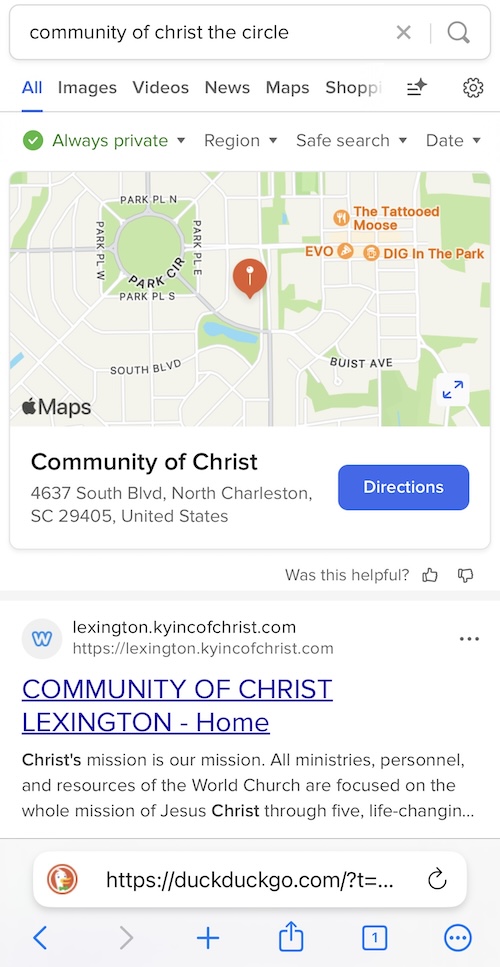
So, here I am searching for something related to the (relatively obscure, relatively progressive) religious denomination I belong to, and when DDG (or maybe Bing) couldn’t find anything related to the specific thing I was searching for, the first text result that it gave me was the best result it could find for a subset of my search matched with the town I live in: Lexington, Kentucky.
the upside-down Blue Marble and imagining other worlds
One of the most famous photographs in the world is the Blue Marble, a picture of Earth taken from Apollo 17 as it made its way to the Moon.

I learned something interesting about the photo today, though: Apparently (see here, among other sources, though I wish I could find a NASA comment on this), the photo was originally taken with the South Pole facing the top of the photo—and with the Earth not exactly centered. Frequently, though, it’s displayed with a vertical flip and some cropping so that it matches our expectations of what the Earth looks like.
Star Trek V, the Liahona, and Jacques Ellul's technique
Despite what my recent Star Trek comics binge might lead you to believe, my Star Trek fandom is actually kind of spotty in its coverage. It’s not so complete that I’ve ever actually seen Star Trek V (though I hear I’m not missing much), but it’s absolutely complete enough to be familiar with its most famous line. A being claiming to be the ultimate, galaxy-wide monotheistic deity asks for transport on the Enterprise, prompting a skeptical Kirk to ask “what does God need with a starship?”
nontheism in one of Steven Peck's short stories
I recently reread Steven Peck’s Wandering Realities, a collection of short stories on Mormonism. One of the more moving stories in the collection is “Two Dog Dose,” which features two old friends, one of whom is still a practicing Latter-day Saint while the other is not. That second character is one of those characters who is more interesting than the brief format has room for: We never learn exactly what led to his loss of faith, but we do learn that he had served as a bishop at some point before that happened. There are tantalizing hints of a rich character that can’t be contained in a short story but who is all the more interesting because that’s all we get of him.
moral surrender, the environment, and generative AI
Last week, I blogged about how the purported inevitability of generative AI gets used to sidestep moral concerns about it. Earlier this morning, I shared a link to a story from The Verge that illustrates that perfectly, and so I wanted to write just a little bit more about it.
First, let’s quote some more from Jacques Ellul, whom I referenced in the last post (and whom I’ve just been referencing a lot in general recently). Right before the passage I quoted in last week’s post—a passage from his 1980 essay The Power of Technique and the Ethics of Non-Power, he had this to say:
two things that bug me about arguments that generative AI is inevitable or whatever
I don’t know that “inevitable” is the right word to use in the title of this post. What I’m trying to evoke is that specific argument about generative AI that now that it’s here, there’s no going back, so the only real/responsible/whatever choice is to learn to use it properly, teach others to use it, accept it as part of life, etc. These are the arguments that the world is forever changed and that there’s no going back—that the genie is out of the bottle so we might as well harness it.
some brief notes on the theme song to The NeverEnding Story
I have vague recollections of watching The NeverEnding Story as a child, but they are vague. I was young (nine at the oldest, but probably younger), it was at someone else’s house, and it was only once, so it didn’t leave much of an impression on me. My next substantive encounter with that movie—or, more accurately, its theme song—was the ending gag in this Homestar Runner cartoon, where the title character sings “the never ending sooooodaaaaaa” to the tune of the movie’s theme song.
Jacques Ellul's technique and Brian Daley's Alderaan
I recently finished an audiobook of Jacques Ellul’s The Technological Society and have been finding other things to listen to now that I don’t have mid-twentieth century French philosophical reflections on technique to think through anymore. Last night, I began (re)listening to the National Public Radio Star Wars radio drama—adapted by Brian Daley—while cleaning up the kitchen, and I continued listening on the way in to work today. The radio drama is interesting in so many ways! For one, it expands a two hour movie into a nearly six-hour radio serial, and so it crams in a lot of material that isn’t present in the movie (or even—as far as I can tell—the original script).
the bronze serpent as anti-universalism and religious exclusivism in the Book of Mormon
Today’s Community of Christ lectionary passage is from 1 Corinthians 10, and includes this, from verse 9 (NRSVUE):
We must not put Christ to the test, as some of them did, and were destroyed by serpents.
This is one of a few different stories that Paul evokes in 1 Corinthians 10 that all rub me the wrong way (I’m not a big fan of any punitive God), but this one stands out in particular because it reminds me of how the “serpents” story (originally in Numbers 21) gets evoked twice in the Book of Mormon. Here they are, from Community of Christ’s Revised Authorized Version:
Jacques Ellul and the value of research
Last month, I wrote on both my reading up on Jacques Ellul and on concerns about how we understand the purpose and value of research. I’m continuing to read—or, rather, listen to—Ellul’s The Technological Society, and I was interested to find a passage that brought together these two ideas. Here’s Ellul, writing in the mid-twentieth century:
We have already examined the requirement of immediate applicability; here we meet it again on the state level. The state is not disinterested any more than private capitalists, but it is concerned in a different way. The state claims to represent the public interest and hence to have the duty of being a “good manager,” dispensing the public revenues only on condition that they mean something, that they pay off. Disinterested activity on the part of the state is inconceivable. Some may such that such activity should not be impossible; but in fact it is impossible. Neither individuals nor public opinion nor the structure of the state is oriented toward the acceptance of the kind of culture pure scientific research would represent.