Below are posts associated with the “Community of Christ” tag.
remembering ordination
I recently passed the second anniversary of my ordination in Community of Christ, and there are a couple of memories from that moment that feel significant enough to write down—and significant enough for them to affect the way that I think about my ministry. I don’t know that I’m doing great with ministry, but I am trying, and as I continue to try, these memories associated with the actual event of ordination are ones that I want to keep in mind.
sermon text on Parable of the Sower
I haven’t been preaching for Community of Christ for very long, but by virtue of different demographics and traditions than the denomination I grew up in (in short, I preach more often for Community of Christ than I would have continuing in Latter-day Saint congregations), I suspect that I may be soon approaching the number of “talks” that I’d given in my past religious life. Maybe not this year, but that might happen in the next couple of years if I keep up the schedule that I’m on. Anyway, I bring that up because in my short time preaching for Community of Christ, I’ve never struggled with a sermon as much as I have with this one, and I’m trying to remember if that’s also true of my contributions to Latter-day Saint worship services over the years.
sermon on idols and certainty
I had another chance to preach for the Beyond the Walls ministry based out of Toronto yesterday. I went a bit off-script in emphasizing passages other than the one I was assigned to, but I’m pretty happy with the result, and I hope it worked out for others, as well. There are a lot of people (Jacques Ellul, Pete Enns, Thomas Römer) whose ideas are floating in the background of this sermon without ever getting mentioned—it channels a lot of thoughts that I’ve had over the past decade or so. Here are the recording and the script:
🔗 linkblog: President Dallin Oaks announces the LDS Church is poised to set a new record
Discourse in the modern American right often understands free speech as protecting the right to say objectionable things but not the ability to criticize people who say objectionable things. While a “one true church” mentality is less problematic than racial slurs or transphobic language (though there’s also some of the latter in Oaks’s full remarks, according to the Church Newsroom release), this excerpt strikes me as embodying a similarly selective view of religious freedom:
on extemporaneous speaking and writing sermons
One of the best things I did for my future self when I was in high school was to follow a friend’s advice to join our school’s forensics (speech and debate) team. Joining the team let me discover something I was good at, and I developed some skills that are tremendously useful to me personally and professionally, not least when teaching or presenting my research.
Lately, as I’ve been putting together some sermons for my local Community of Christ congregation and the Beyond the Walls ministry in Toronto, I’ve thought about another way that competing in forensics decades ago has shaped me. One of my particular strengths was competitive extemporaneous speaking, which involved having half an hour to write and memorize a seven-minute speech on a semi-randomly chosen topic related to domestic and foreign affairs. (I also did fairly well in impromptu speaking, which involved slightly shorter speeches with drastically shorter prep time).
sermon on the Ascension and fleeting joys and hopes
I got the chance to preach in my home congregation yesterday and wanted to post the text here. In high school, I competed in extemporaneous and impromptu speaking (these were two different competitions with two different formats in Kentucky speech and debate, so I’m not just rattling off synonyms). This is something which has really impacted my life in terms of teaching me how to think on my feet. In the context of giving sermons, I usually know more or less what I want to say within a few minutes of reviewing the passage that I’m assigned to, though over the days and weeks that follow, I spend a lot of time figuring out the details of what I want to say. I really felt that with this sermon: The text I used on Sunday morning was the third draft of a sermon, and I even made some last minute changes over breakfast. I’m fairly happy with how it turned out, though there are parts of previous drafts that I missed, too.
on disregard for heresy and the unrealized queer potential of Mormonism
As I’ve noted a few times before, I’m a de facto Trinitarian, but I can’t say that I’m tremendously invested in the Trinity as an orthodox doctrine of Christianity. I know that some of this has to do with my Mormonism—growing up in a non-Trinitarian tradition has surely shaped my thinking about this—but I don’t think that’s really what’s going on here. Yes, I’m often sympathetic to the beliefs of the tradition I spent so much time in, but I’m also a non-theist who tends to see God as more of a metaphor for humans’ fleeting experiences with the ultimate than as someone whose nature and consubstantiality can (and must) be understood in distinct terms.
📚 bookblog: Exploring Community of Christ Basic Beliefs: A Commentary (❤️❤️❤️🖤🖤)
Like the last Tony-authored book I reviewed, I want to concede that there’s a bit of unfairness coming into my review. In some ways, I think it’s an important work that just isn’t what I’m looking for right now. What’s more, it’s kind of a reference work that I tried to read cover to cover, and that affects my thinking, too. However, I also have some grumps about it that I think are valid.
exploring grace and generosity (and the recalcitrant rich) through two translations of a psalm
Over the past few months, one of my afternoon traditions has been to take a short break to read through the day’s passages in Shane Claiborne, Jonathan Wilson-Hartgrove, and Enuma Okoro’s Common Prayer: Liturgy for Ordinary Radicals. I bought this book after being impressed by Claiborne’s work in Jesus for President (which is much more radical than the title sounds) and with the hopes that it would be another resource for me as I continue to learn about the liturgical calendar. I didn’t stick with it long during the 2024-2025 liturgical year, but I’ve been having more luck with the 2025-2026 liturgical year. Sometimes, I’ll admit, I just go through the motions, but every once in a while, something really stands out to me.
on being glad BYU wasn't hiring when I was on the job market
I can’t remember why I had a version of this post bouncing around my head several months ago—maybe a Times and Seasons post? probably a message from an acquaintance at BYU who isn’t up to date on my religious situation?—but I never got around to writing it. With Clark Gilbert’s call to the Latter-day Saint Quorum of the Twelve Apostles today, it felt like a good moment to actually get those thoughts out of my head and into a text file.
a sermon in which I implicitly call Tim Cook a coward
It was last November that I signed up to preach on Isaiah 58:1-12 (“Bring an End to Oppression”) on February 8th, and it was depressing how much the universe gave me to work with over the course of the first few weeks of 2026. I knew from the beginning that I wanted to address the idea of the prophetic critique in Isaiah and invite those of us in the service to emulate that critique in our own day. What I had trouble figuring out—almost right up to the end—was what I wanted to use as examples.
sermon on deciding which Jesus to follow
I had the opportunity to preach yesterday for Reign of Christ Sunday. Reign of Christ Sunday is one of those liturgical moments that admittedly makes me a little nervous: I like the idea of putting Jesus first, but it really, really depends on what we understand by Jesus. (I’ve been writing on this for a while, it looks like.) So, I decided to take the opportunity to invite members of my congregation to reflect on who Jesus is for them and what it means to put that Jesus first. Here’s the sermon text:
new publication: online space in a Community of Christ congregation
A couple of years ago, I worked with a graduate student to examine the geographic and linguistic diversity in an online Community of Christ ministry that made an intentional effort to cross borders during the COVID-19 pandemic (and before and since, but for all of the obvious reasons, this was particularly pronounced during the pandemic). I was pleased with how the work went and was eager to get it to publication. I’m happy to announce that that’s finally happened, thanks to the Journal of Media and Religion.
lines from the existential horror comic Ice Cream Man that I could work into sermons
For reasons I don’t have to get into here, summer is one of the hardest times of year in mental health terms, and over the course of the past few months, I’ve had my fair share of existential dread and feeling adrift. As I wrote last week, that meant that I was hesitant to start reading the comics series Ice Cream Man, because I was afraid that it would further fuel that dread.
practicing anarchist utopia at church camp
A year ago today, I wrote a post describing the difficult time I’d had that year attending a local “Reunion” (family camp) put on by Community of Christ. That reminded me of a post I’ve been meaning to write for months about this year’s much more positive experience at Reunion, so it’s time to get those thoughts out of my head and into a post.
Over the past couple of years, I’ve read a fair amount of anarchist fiction, and I’ve found that I like it. A lot. I don’t know that I’m ready to become a committed anarchist in the real world, but I love the way that anarchist fiction does two things: first, it dares to imagine a better world than the one we live in; second, it believes that human beings are capable of collectively creating this better world—and without being forced to do. One of my favorite imaginings in this genre of fiction comes from Ursula K. LeGuin’s The Dispossessed, where Shevek (the main character, from the anarchist moon Anarres) explains to some colleagues that in his home, everyone pitches in to take care of undesirable tasks like cleaning up waste (I can’t remember if this is human waste or industrial waste or something else… I really need to get a copy of this book so I can reference it for posts like this).
🔗 linkblog: Statement Regarding 80 Years Since the First Use of Nuclear Weapons | News | Community of Christ
Glad to belong to a church that takes positions on moral issues like this one.
recent sermon text on finding the Ultimate in the ordinary
Just over a week ago, I preached for the Beyond the Walls online ministry up in Toronto. I wanted to post the text of my sermon (I’ll also link to the video recording just before that text begins). I was excited about this particular topic, since it fit nicely with some thinking I’ve been doing in recent years, includingwhile reading Cédric Lagandré’s book Dieu n’existe pas encore and writing up some subsequent thoughts. I imagine I’ll continue to think on these kinds of themes, but I was pleased with how much the burning bush story—and Jesus’s riffing off of it in the Gospel of John—contributed to my thinking at this particular time.
📚 bookblog: Christ in the Rubble: Faith, the Bible, and the Genocide in Gaza (❤️❤️❤️❤️❤️)
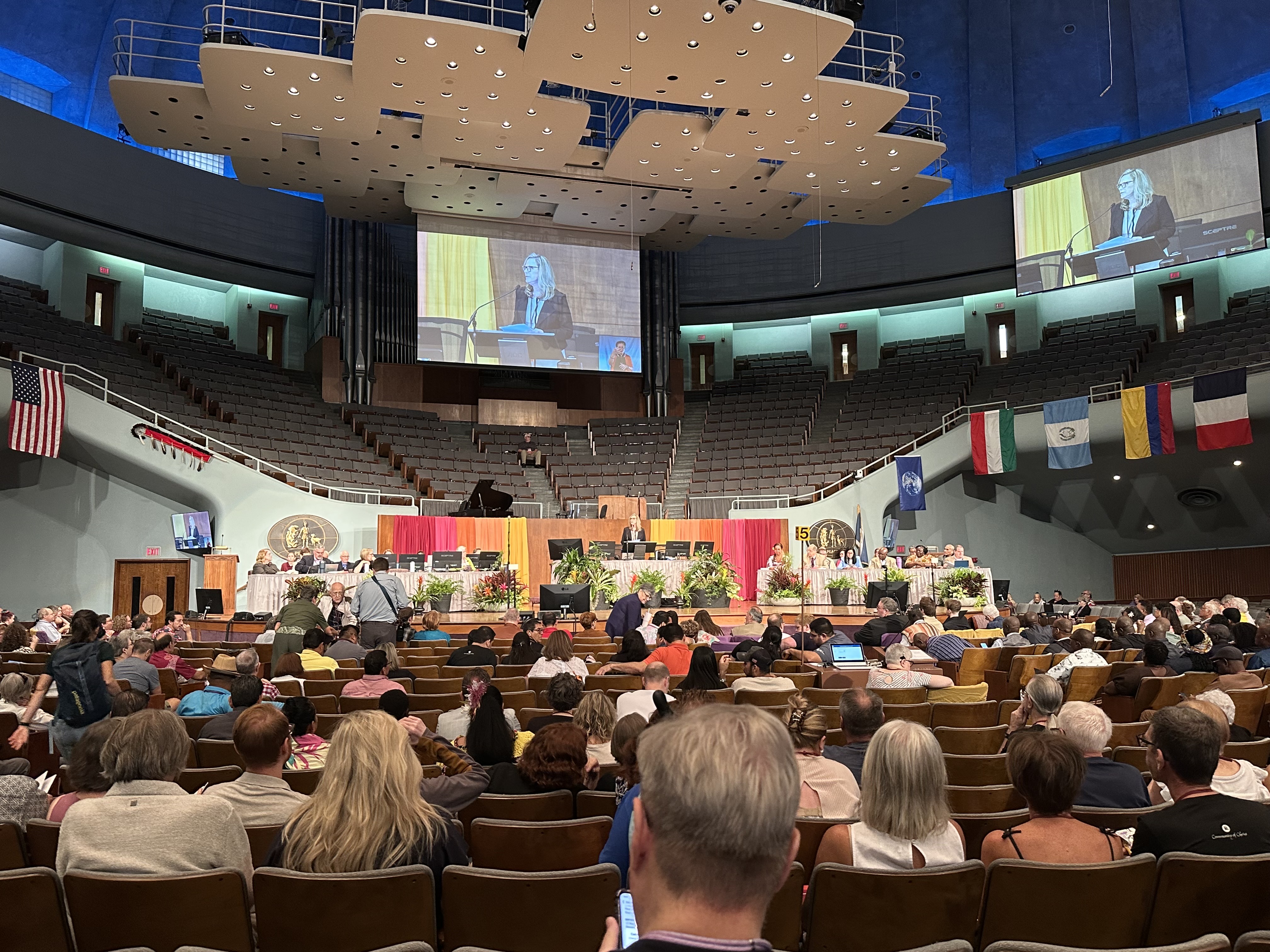
This was a hard book to read, but I’m glad I did. Munther is a Palestinian Christian pastor, and his holy anger and hurt in this book really spoke to me. However, I have a lot of internalized resistance to what he has to say, and things feel so big, and I spent a lot of the book tensing up and feeling overwhelmed. I feel called to repentance by this book, and I’m glad I read it before next week’s Community of Christ World Conference, where a resolution standing against Christian Zionism will be debated.
technology in Community of Christ's efforts to become a 'prophetic people'
I spent a lot of the morning anxious about generative AI after reading about other professors’ struggles with how the technology has upended how we teach. It’s long been frustrating to me that teachers and others bear the burden of adapting to a world that big tech companies have created, seemingly with the goal of enriching themselves. Later in the morning, I read a worrying story about how a company called Flock is building tools that will let customers of their automated license plate readers (including Lexington, the city I live in) do even more invasive surveillance of the people they pick up on their cameras.
preaching on Revelation: hope, weirdness, and being anti-empire
Last Sunday, I preached in my Community of Christ congregation, beginning five weeks of messages from Revelation. This sermon came together with more difficulty than the last few that I’ve done, but I took advantage of being the first person preaching on Revelation by setting the stage for a responsible reading of the book as about the past, not the future. I attend a relatively conservative Community of Christ congregation, so it was unsurprising to get some pushback on that, I guess. I also managed to work one of my favorite novels into that explanation, which was fun. I think I could have gone harder with the message of anti-imperialism, but I’m pleased with what I did fit in there.