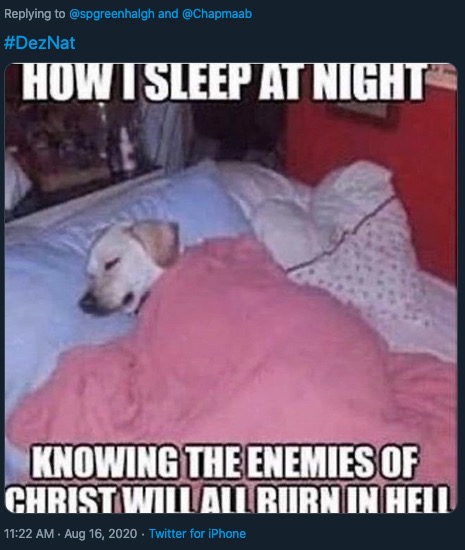
Below are posts associated with the “DezNat” tag.
where I'm cited on Wikipedia
Last week, I read a post from Andrew Heiss on Bluesky that inspired me to take a look at whether/where I was cited on any Wikipedia articles. I knew my research had been referenced on one particular page, but I’d never done a thorough search for this and decided to give it a whirl.
While I can’t claim anything as cool as the page on Hosni Mubarak (where Andrew’s research is cited), my research is referenced on three different Wikipedia articles, which feels pretty cool, actually. It seems like my newer Mormon Studies work is what is getting traction on Wikipedia, as opposed to my historical (and continuing) focus on educational technology research. This doesn’t totally surprise me; I’ve observed for a couple of years (or longer) that while my edtech research gets a whole lot more scholarly attention, my Mormon Studies work tends to get more media and popular interest. I attribute this to doing niche work on subjects where a smaller number of people show a greater amount of interest in what I’m studying.
🔗 linkblog: The Trump Administration Is Using Memes to Turn Mass Deportation Into One Big Joke
Bookmarking this so I can point to it if anyone asks why I’ve shifted my research from ed tech to right-wing Mormonism.
research referenced in Salt Lake Tribune article on social media and Mormon masculinity
This last weekend, I made a brief appearance in an article from the Salt Lake Tribune discussing the influence of social media on Mormon masculinity. As I’ve noted before, the Tribune aggressively paywalls, but it’s hard to fault them. I get access to their religion coverage by paying $3/month to the Patreon for their Mormon Land podcast.
My appearance is brief—a simple mention that Jordan Peterson is mentioned a number of times in a forum site I’m studying with colleagues—but those colleagues (Levi Sands at the University of Iowa and Amy Chapman at Arizona State) have more to say about the unsurprising, ambiguous, and worrying overlap between figures like Peterson and Andrew Tate and online Mormonism. Indeed, the article later quotes one Mormon influencer as describing “Guys like Andrew Tate” as “colleagues of mine,” and the influencer in particular is a familiar face from the work Amy and I have done on the DezNat movement from Mormon Twitter.
bad faith uses of scientific 'rigor'
I have conflicted feelings about productivity books, but even as I increasingly reject the emphasis on productivity, I do find that there are some gems in these books that are helpful to me as I try to keep my life organized across all of its dimensions. While rereading one of these books over the summer, I came across the following quote (which appears to be a misquotation of Oliver Wendell Holmes, Jr.):
interviewed for Salt Lake Tribune article on far-right influences in Mormon Twitter
I recently had the wonderful opportunity to be interviewed by Salt Lake Tribune religion reporter Tamarra Kemsley about work that Amy Chapman and I have been doing on the reactionary DezNat movement within Mormon Twitter. Our conversation largely focused on the article that Amy and I published last year on far-right and anti-feminist influences within DezNat, but I got to pull in some observations from an article on DezNat perceptions of religious authority that is currently under review and some work on broad patterns in DezNat activity between early 2019 and late 2022 that we’ll be presenting at October’s meeting of the Society for the Scientific Study of Religion (more specifically, within a session organized by the Mormon Social Science Association).
research on anti-feminist online Mormonism referenced in Salt Lake Tribune column
I enjoy reading Natalie Brown’s columns for the Salt Lake Tribune, so it was a real honor that she referenced research that Amy Chapman and I did on the “DezNat” Twitter movement in last Saturday’s installment. In particular, Brown referenced a comment I made to the Tribune last summer that our findings highlighted anti-feminist influences on the DezNat movement (which has typically been criticized for its far right influences) and that while the Church of Jesus Christ of Latter-day Saints
follow up on research ethics implications of Twitter's 'general amnesty'
This is just a few words to say that this post that I wrote back in December 2022 has suddenly become relevant.
In short, some of my recent work has been on an online Mormon community that has some overlaps with the far-right. In between my collection of the data and eventual publication of our various articles, my co-author and I have noted some prominent accounts’ being suspended from Twitter. Because we work hard to not use identifiable quotes in our writing, and because of Elon Musk’s decision to unsuspend nearly all suspended accounts after taking the platform over, I’ve been checking accounts I knew to previously be suspended as we work on a new manuscript. Today, for the first time, I’ve found one account that has indeed been unsuspended.
far-right Mormonism and the boundaries of Twitter hashtags
There are a couple of weeks before the deadline to submit abstracts for the Mormon Social Science Association’s sessions at the 2024 meeting of the Society for the Scientific Study of Religion, so I’ve been filling some nooks and crannies of my busy work week by looking at some Twitter data. Last year, I published with my colleague Amy Chapman a qualitative look at the #DezNat Twitter hashtag, which blends Mormon orthodoxy with far-right and anti-feminist thinking.
upcoming research talk on DezNat for Bainbridge Latter-day Saint fireside series
A couple of months ago, Peggy Fletcher Stack of the Salt Lake Tribune mentioned the work that Amy Chapman and I have been doing on the far-right-influenced DezNat movement. Shortly after Peggy’s article was published, someone who coordinates an unofficial series of Latter-day Saint-related firesides reached out to us about speaking to their group about our research on the DezNat movement. Before accepting, we made it clear that our work isn’t devotional, neither of us are practicing Latter-day Saints, and our work could be understood as critical of cultural and institutional Mormonism; however, the fireside organizers said that they were used to getting into controversial topics related to Mormonism and that our work was welcome with them. With that clarified, this was actually one of the most flattering invitations I’ve received to speak about my research. Over the past several months, I’ve found that there’s a large non-academic audience for Mormon Studies research, and it’s been great to get some attention from parts of that audience for my ongoing research.
quoted in Salt Lake Tribune article on DezNat movement
This past weekend, Peggy Fletcher Stack at the Salt Lake Tribune published an article about the #DezNat movement on Mormon Twitter, which takes cues from far-right and anti-feminist online communities. In her article, Peggy was kind enough to reference (and quote from) my new publication with Amy Chapman in the Journal of the Mormon Social Science Association, which presents the (partial) results of a qualitative analysis of over 1,400 DezNat tweets from 2019.
new publication: far-right and anti-feminist influences on a Mormon Twitter hashtag
I am very happy to announce that a paper I wrote with Amy Chapman is finally published and available open access in the Journal of the Mormon Social Science Association (I have also archived a PDF of the article on my website, available at this link). Amy and I began this project in the spring/summer of 2019, so it’s a relief to finally see our first paper in print.
In short, the paper is a descriptive look at tweets using the #DezNat hashtag; DezNat, short for either Deseret Nation or Deseret Nationalism (depending on who you ask) is a movement of arch-conservative Mormons on Twitter and elsewhere on the internet. As an internet researcher with a deep familiarity with Mormonism, I felt like this was perfect research for me to tackle (something I’ve written about before). We qualitatively coded 1,378 screenshots of tweets (part of the reason that this took so long to get to print), and wound up with a wealth of data and findings. This first paper is focused on red pill (i.e., far-right and anti-feminist) influences in the hashtag, making a scholarly contribution to some of the popular and media discussions about the DezNat movement. Here’s the abstract for the paper:
🔗 linkblog: Instagram Has a White Nationalist ‘Groyper’ Problem'
I wish this weren’t as relevant as it is to my work on Mormon Twitter, but here we are.
unexpected research ethics implications of Twitter's 'general amnesty' for suspended accounts
For over three years now, I’ve been getting increasingly involved with research projects that involve the online far right in one way or another. One of the most interesting ways that I’ve developed as a researcher during this time is having to think through in greater detail my commitments to research ethics. Because my research typically focuses on public social media data, I am rarely required to obtain informed consent from those whom I study. Of course, I agree with many internet researchers that this does not absolve me of my ethical responsibilities (I find Fiesler and Proferes’s 2018 paper on this subject particularly helpful). This becomes even trickier, though, when the unwitting “participants” in my research espouse views that I find objectionable. To what extent do I, as a researcher, owe a Twitter (or Gab) user privacy and dignity if they are engaged in homophobic, misogynist, or white nationalist behavior? I’m still figuring this out, but my approach right now—informed heavily by this paper—is to try to err on the side of respect for the user whenever possible.
new publication: LGBTQ+ communities and far right social media
I’m pleased to share that a study I contributed to—Gayservatives on Gab: LGBTQ+ Communities and Far Right Social Media—is now available (open-access!) through the Social Media + Society journal. Dr. Evan Brody is the lead author on the study, and we were lucky enough to have support from PhD student Mehroz Sajjad. Here’s the abstract for the study:
In the United States, LGBTQ+ individuals are often imagined as inherently politically progressive, but this assumption overlooks the experiences of self-identified LGBTQ+ conservatives. Likewise, although social media platforms are recognized as spaces of identity and community production for LGBTQ+ people generally, less work has considered how they provide a similar forum for “gayservatives.” In response, this article engages in a critical discourse analysis of LGBTQ+-oriented groups on the far right social media platform Gab. Results indicate that far right social media is utilized to connect with other politically similar LGBTQ+ individuals perceived to be absent in one’s offline community. Participants do so via discourses that both regulate and celebrate LGBTQ+ identities, particularly as it relates to hegemonic masculinity. These strategies generally reinforce, but at times reframe, stereotypical narratives about LGBTQ+ individuals. This study provides groundwork for more nuanced understandings of both LGBTQ+ conservatives and the ways power is socialized and embodied through discourses about sexual and gender identities.
new presentation: reactionary Mormons and religious authority online
Last week, I had the pleasure of attending the 2022 meeting of the Society for the Scientific Study of Religion to present research with Amy Chapman on how the reactionary DezNat movement on Mormon Twitter conceptualizes and claims—but ultimately problematizes—religious authority in the online sphere. We presented in one of the sessions sponsored by the Mormon Social Science Association and were lucky enough to have some good conversations and receive some helpful feedback.
when niche research pays off
In my second-to-last year of grad school, I was asked to give a research talk as part of my program’s prospective student day. My talk was representing the “educational technology” part of the program, and the incomparable Kristy Robinson gave a talk reresenting the “educational psychology” part (to this day, when I’m struggling with a bout of imposter syndrome, I still remind myself that my grad program let me present alongside someone of Kristy’s caliber, so I must have something going for me).
some thoughts on Gab pushback against research on Gab
I’m not going to link to it, but I am fascinated by a recent post on the Gab blog where Andrew Torba announced some new features to help Gab users push back against research on the platform. Not only do I have two or three ongoing projects using Gab data (one is in the very, very early stages and—ironically—uses Gab blog posts), but some of what Torba wrote also aligned with some of the (fortunately mild) trolling my co-author, Amy Chapman, and I have experienced because of my work on the far-right-influenced DezNat hashtag in Mormon Twitter. So, I thought I’d write up some of what stood out to me in the post.
Dallin Oaks and Marjorie Taylor Greene on heterosexual extinction
Thanks to a recommendation from BoingBoing, I just finished reading a Business Insider article describing a recent video in which Marjorie Taylor Greene:
predicted that identifying as heterosexual will be a thing of the past within a period of less than 200 years thanks to LGBTQ-inclusive sex educators, who she called “trans terrorists.”
More specifically, Greene was quoted as saying that heterosexual extinction would come about “probably in about four or five generations.” Referrring to “generations” in the context of a purported heterosexual extinction felt familiar to me. In fact, as horribly queerphobic as Greene’s message was, she was actually more optimistic than Latter-day Saint General Authorities have been in the past.